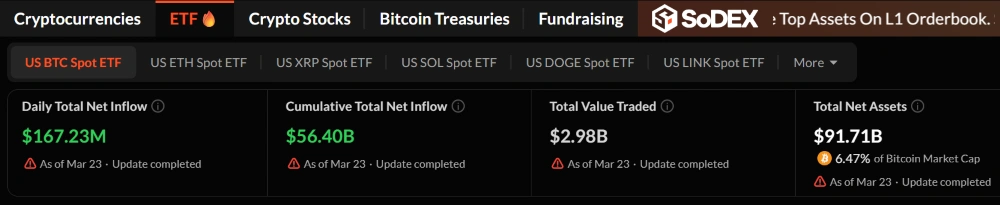
A significant capital rotation is underway in institutional markets. US spot Bitcoin exchange-traded funds (ETFs) recorded $167.23 million in net inflows on March 23, snapping a three-day outflow streak, while traditional safe-haven assets saw massive redemptions. According to SoSoValue data, the daily figure extends a four-week positive streak for Bitcoin spot products, which have accumulated approximately $1.53 billion through March 20 .
Bitcoin ETFs Bounce Back After Three-Day Lull
The $167.23 million inflow marks a decisive reversal after three consecutive days of outflows that had raised questions about the sustainability of institutional demand. The cumulative total net inflow for all US spot Bitcoin ETFs now stands at $56.40 billion, with total net assets under management reaching $91.71 billion, representing 6.47% of Bitcoin’s total market capitalization .
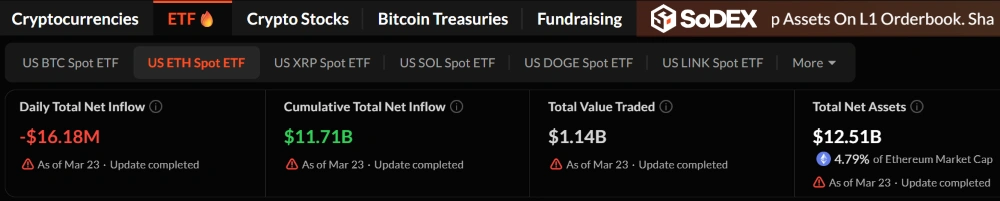
The positive momentum was not limited to Bitcoin. Ethereum spot ETFs recorded $16.18 million in daily net inflows, bringing cumulative inflows to $11.71 billion. Total net assets for ETH products now stand at $12.51 billion, or 4.79% of Ethereum’s market cap, with daily trading volume hitting $1.14 billion .
The Great Rotation: Gold Bleeds Billions
While Bitcoin ETFs attracted fresh capital, traditional safe-haven assets faced significant outflows. SPDR Gold Shares (GLD), the world’s largest gold-backed ETF, posted record monthly outflows in March, with investors redeeming billions as they rotated into yield-bearing alternatives and digital assets .
The divergence between Bitcoin and gold has reached historically significant levels. According to data from CryptoQuant, the Bitcoin-to-gold correlation has plunged to -0.88, the lowest level since November 2022. This negative correlation indicates that the two assets are moving in opposite directions with strong intensity—a phenomenon that underscores the changing dynamics of institutional portfolio allocation .
Bitcoin-to-Gold correlation just hit -0.88, the lowest since Nov 2022.
— CryptoQuant.com (@cryptoquant_com) March 18, 2026
This means Bitcoin is moving in the opposite direction with strong intensity.
Capital flows into Bitcoin have driven its price up to $74K, while gold has experienced a slight decline. pic.twitter.com/UMJZAfACKn
📌 Twitter Embed Açıklaması: CryptoQuant tarafından paylaşılan grafik, Bitcoin-altın korelasyonunun Kasım 2022’den bu yana en düşük seviye olan -0,88’e gerilediğini gösteriyor. Bu, iki varlığın zıt yönlerde güçlü bir şekilde hareket ettiği anlamına geliyor.
Bitcoin Outperforms Gold and Equities
The rotation comes as Bitcoin continues to demonstrate relative strength against both traditional safe havens and risk assets. Bitwise’s latest Crypto Market Compass report highlighted that Bitcoin is outperforming gold and equities, even as sentiment remains slightly bearish amid rising geopolitical risks .
🚨NEW REPORT 🚨
— Bitwise in Europe (@Bitwise_Europe) March 16, 2026
Bitcoin is outperforming gold and equities. Sentiment remains slightly bearish amid rising geopolitical risks.
Read more in our latest Crypto Market Compass report! 👇 pic.twitter.com/saiMF6VBjG
📌 Twitter Embed Açıklaması: Bitwise Europe’un raporunda Bitcoin’in altın ve hisse senetlerini geride bıraktığı, jeopolitik risklere rağmen duyarlılığın hafif düşüşte kaldığı belirtiliyor.
What’s Driving the Rotation?
Several factors are converging to drive capital from gold into Bitcoin:
1. ETF Accessibility: The launch of US spot Bitcoin ETFs has made it easier than ever for institutional investors to gain exposure to Bitcoin through familiar, regulated vehicles. This accessibility has lowered barriers to entry and facilitated large-scale capital allocation .
2. Diverging Macro Narratives: While gold traditionally benefits from geopolitical uncertainty, rising real yields and a stronger dollar have weighed on the yellow metal. Bitcoin, meanwhile, has been viewed by a growing cohort of investors as a distinct macro asset with its own demand drivers .
3. Four-Week Inflow Streak: Bitcoin ETFs have now recorded four consecutive weeks of positive flows, totaling approximately $1.53 billion through March 20. This sustained demand provides a structural bid for the asset, distinguishing it from previous speculative cycles .
4. Record Cumulative Inflows: With cumulative Bitcoin ETF inflows surpassing $56 billion, the product category now represents a significant portion of Bitcoin’s total market cap. The $91.71 billion in total net assets under management underscores the depth of institutional participation .
Ethereum ETFs Also See Resurgent Demand
The positive sentiment extended to Ethereum products, which recorded $16.18 million in daily inflows. Cumulative inflows for ETH ETFs now stand at $11.71 billion, with total net assets of $12.51 billion. The daily trading volume of $1.14 billion indicates robust liquidity and active participation .
While Ethereum’s inflows are smaller than Bitcoin’s in absolute terms, the relative size of ETH ETF assets (4.79% of Ethereum’s market cap) is comparable to Bitcoin’s 6.47%, suggesting that institutional adoption is proceeding at a similar pace for both assets .
Outlook: The Rotation May Accelerate
The negative correlation between Bitcoin and gold, combined with record outflows from gold ETFs and sustained inflows into Bitcoin products, suggests that a structural shift in institutional allocation may be underway. As more investors recognize Bitcoin’s role as a portfolio diversifier and potential hedge against fiat debasement, the rotation could accelerate .
Key levels to watch: Bitcoin’s ability to hold above $70,000 will be critical for sustaining ETF inflows. For gold, the $4,500 level represents a key psychological support; a break below could trigger further outflows and accelerate the rotation .
With the Federal Reserve’s policy path remaining uncertain and geopolitical risks persisting, the divergence between Bitcoin and gold may continue to widen, reshaping the landscape for institutional portfolio construction .
Sources: SoSoValue, CryptoQuant, Bitwise, SPDR Gold Shares.